|
If any word is underlined, you can click on to get more detail. Click on the photo to enlarge it and see more photos if available.
| Make |
Moog |
| Model |
Taurus |
| Description |
The Moog Taurus bass pedal synth was a totally unique product at the time in that it was a simple bass synth that could be played with the feet. The Moog Taurus by its design is meant to be played by foot although can be played and triggered by hand.
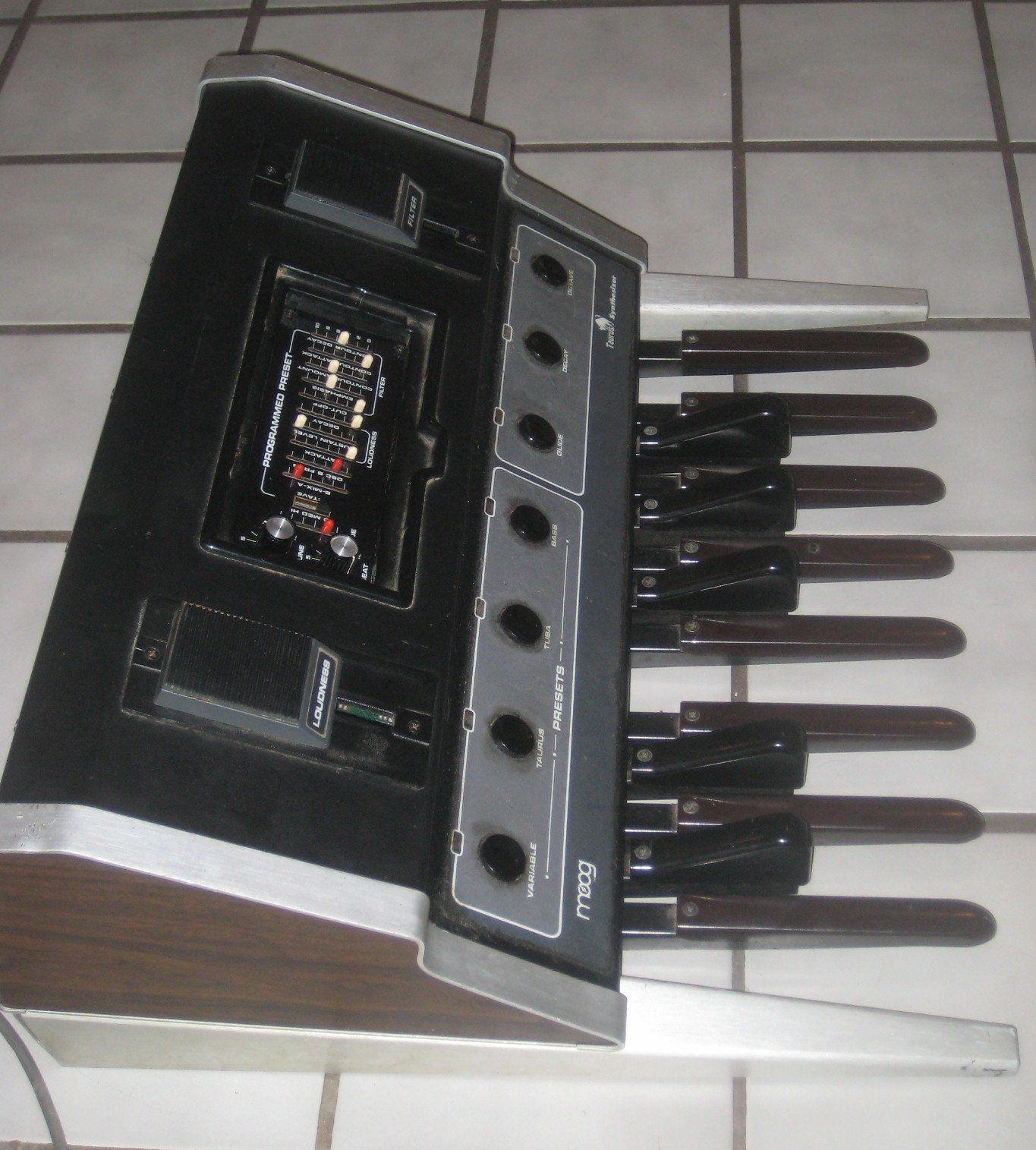
This set of Moog Taurus I pedals is in very good condition. It is missing the flip-up window that normally covers the variable setting Controls. Also, one of the red LED indicators lights above the sound selection foot switches does not activate. Everything else is fully functional, and it has had service adjustments made to it, so it stays nicely in tune, and sounds great!
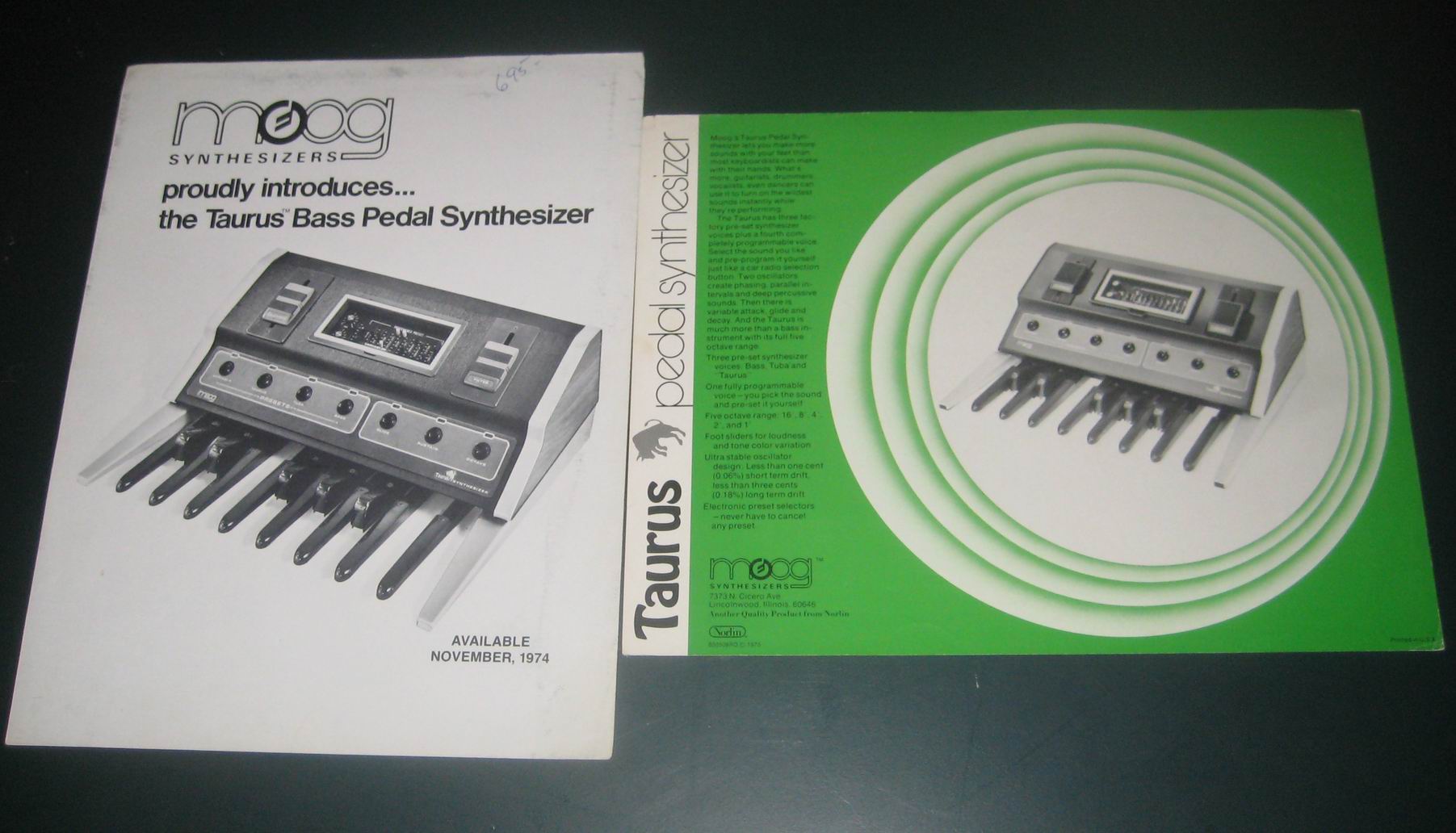
Includes photocopies of the operation and service manuals with schematics, as well as an original Moog Taurus I spec sheet (pictured).
The Taurus was originally planned as a component of a big synth system called the Constellation, comprising the Apollo (which became the PolyMoog) for chords, the Lyra (which became the MultiMoog) for melodies and the Taurus pedals for bass accompaniment and the proposed system was not unlike some huge (and expensive!) hi-tech organ. Of course, this system never really saw the light of day, other than the Apollo and Lyra prototypes which were used by Keith Emerson during the Emerson, Lake and Palmer Brain Salad Surgery album and tour, but the items were sold separately instead.
The Moog Taurus I bass pedals were released in the mid-'70s to much acclaim.... they hit the spot with the then popular progressive rock bands for adding an extra element to their stage productions.
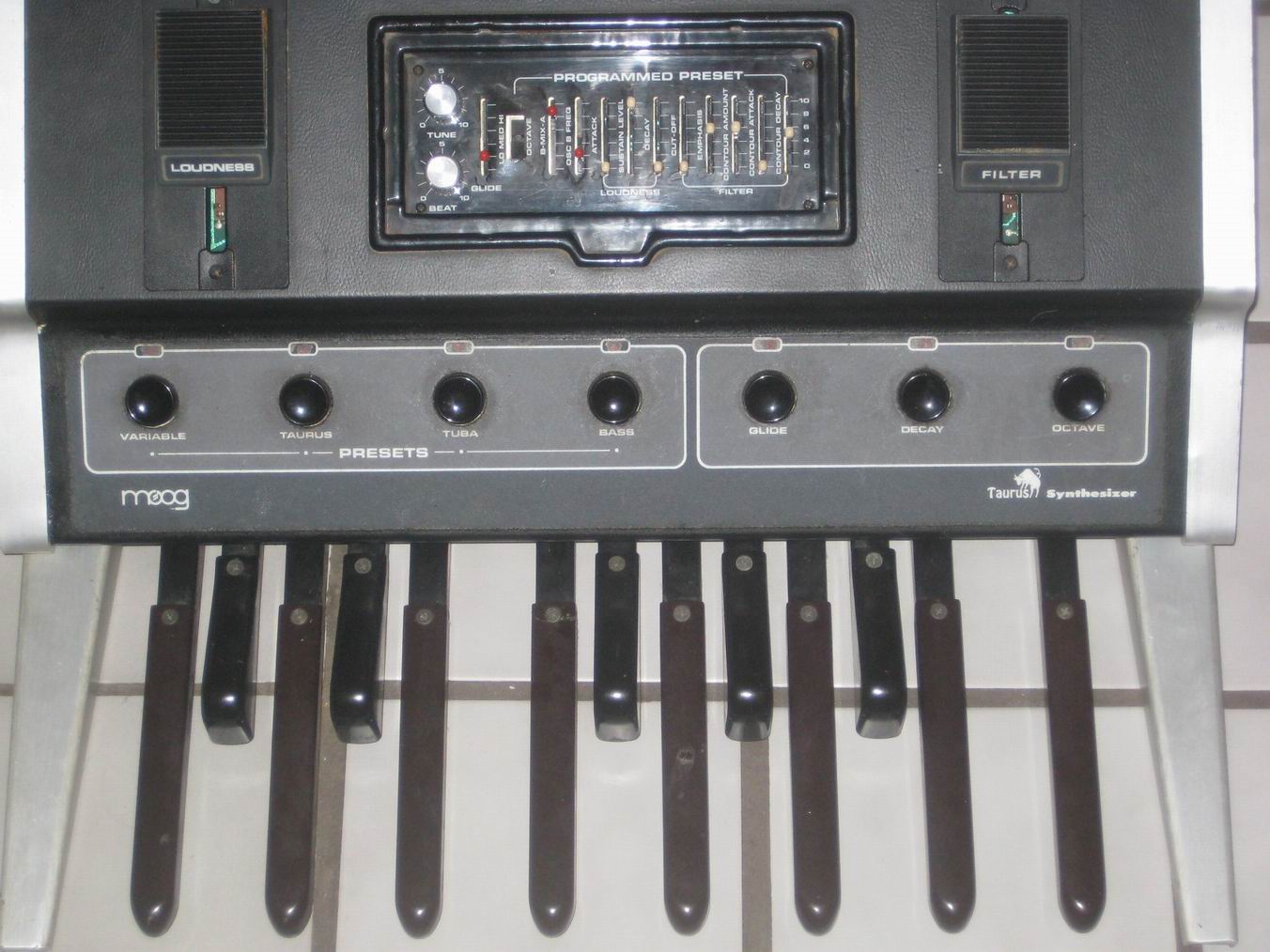
The Moog Taurus I is housed in a rugged aluminum and wood casing and, although known primarily for its bass timbres, has a five-octave overall range. It is a monophonic analog synthesizer with an overall range of 5 octaves triggered by a 13 note set of pedals (1 octave C to C configuration). Three stock preset sounds are available along with one user-programmable Variable sound - the parameters of which are adjustable within a top, centrally located compartment. The three non-variable Presets are named Tuba (single oscillator), Bass, and the famous Taurus. The following parameters are foot switchable: Glide (on/off), Octave (+ 1 octave or Normal), Release (long release on/off), and the three stock Presets and one Variable Preset. Top mounted foot controlled sliders affecting volume (Loudness) and filter cutoff (Filter) are also provided. A unique feature of the Octave function allows the player to change this footswitch setting while an unpressed note was sounding, with actual transposition only taking place immediately upon the next note press, allowing for smooth, predictable changes during performance and recording. The Taurus I's FET-based integrator oscillator and classic Moog 24dB/Oct Low Pass Filter produce a unique, edgy, penetrating timbre which is not exactly duplicated by any other instrument and is widely regarded for its extremely rich, 'fat' sound, which is oftentimes more felt than heard when greatly amplified.
The Taurus synth engine is a basic 2-oscillator affair through the famous Moog filter and two simple envelopes - one for the filter, the other for amplitude shaping - with switchable release. Although a fairly simple synthesizer design, What users were paying for was the 'concept'.... the notion of being able to add bass lines to their music whilst their two hands were otherwise occupied. They were also paying for the Taurus's astonishing build quality - it was a big, heavy affair that was built like a tank to withstand being stamped on.
Four footswitches were provided to select presets (Tuba, Bass, Taurus and Variable) and others to switch glide on and off, to transpose the sound up and down and to switch envelope release on and off. Two large 'footsliders' at the top of the instrument allowed you to control level and filter cutoff with your feet and so it was possible to achieve a fair amount of 'hands-free operation on-stage.
Each bass tone pre-set can be played at a low and high octave and can be additionally filtered using the master filter foot control. Controls for tone Glide and tone Decay are also available. Over each foot switch is a red LED indicator that lights when a particular setting is active.
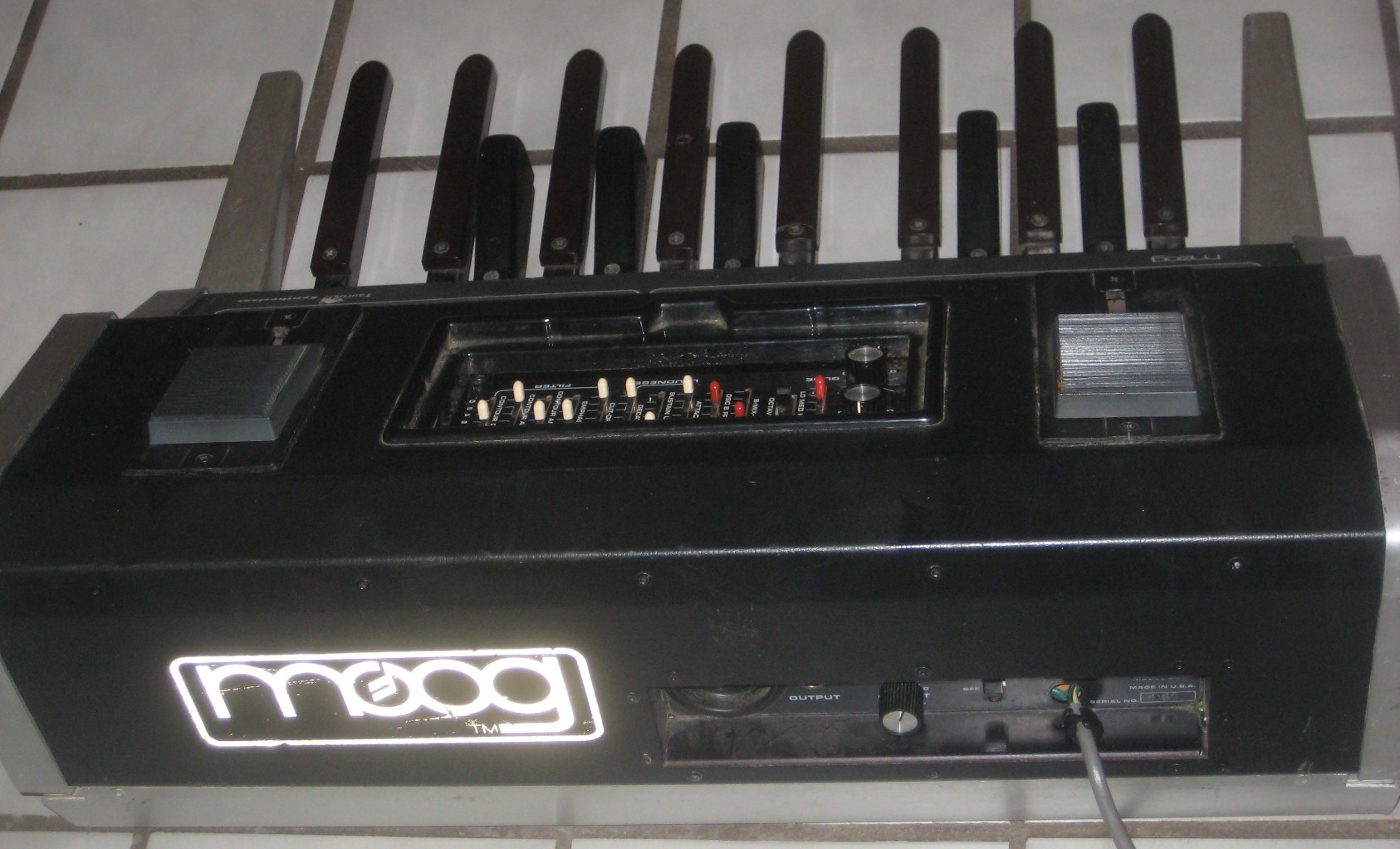
More in-depth programming was possible by lifting the flap on the top of the panel where the simple synth was laid out using a handful of small sliders - these settings were selected with the VARIABLE 'preset'. The Moog Taurus also is equipped with a Variable setting that can be adjusted with a set of filtering and tone controls contained in the Taurus’ Variables section. The variable setting allows the player a range of 3 octave settings (Lo, Med, Hi) for the primary oscillator. The secondary oscillator can further be set an octave higher or lower than the primary oscillator. Inside the variables section are controls for master tuning the unit. A fine tuning control “Beat” is also available to further tweak the sound and can be used to produce a wavering sound.
All tones and settings can be further controlled by the performer and changed with top-mounted, foot-manipulated master volume and filter controls. The Taurus I has a 'low note priority' keying circuit. In the event that the player depresses two notes, the instrument will only sound the lowest pitched note, similar to other monophonic synthesizers. The Taurus I oscillators produce only sawtooth waves.
Power comes from a standard 110V grounded plug attached to the back panel located next to the master power switch. Sound is output using a standard instrument cable inserted into a 1/4 inch output jack. A control for the unit’s final output level is also located on the back panel.
The legendary Moog Taurus bass pedal synthesizers were produced and sold by Moog Music from 1975 to 1981, and are known for their distinctively fat analog bass sounds.
Taurus pedals were used by a range of rock, metal, soul, R&B and fusion performers, including Cold Chisel and Michael Jackson on Stacy Lattisaw's 1980 song 'You Don't Love Me Anymore', Ritchie Blackmore, Pink Floyd, Neurosis, Electric Light Orchestra, Yngwie Malmsteen, Geddy Lee and Alex Lifeson from Rush, Styx, U2, John Paul Jones from Led Zeppelin, Jon Anderson and Chris Squire from Yes, Jon Camp of Renaissance, Sting and Andy Summers of The Police, and Mike Rutherford, Steve Hackett & Daryl Stuermer of Genesis. Genesis drummer Phil Collins brought the Taurus sound to Top 40 radio with his hit single, 'I Don't Care Anymore', which features Taurus bass pedals as the sole source of bass in that song.
Mike Rutherford of Genesis replaced his old Dewtron bass pedals with the Taurus. He would use the Taurus whilst playing 12-string guitar and the sound is evident on many of the post-Gabriel Genesis albums, especially the live album 'Seconds Out'. Fellow band member, Steve Hackett, also used them (and apparently Tony Banks, the band's keyboard player). Ex-Genesis guitarist Steve Hackett had a set mounted waist high which his brother, John Hackett, used to play with his hands for the song Clocks - The Angel Of Mons from the album Spectral Mornings.
The sound of the Taurus is legendary... thick and fat with pulsating detuned oscillators and, of course, that famous Moog sound. The actual Taurus preset is a classic - it has a moderately bright attack which decays to a deep, powerful and solid sustain.... it is just about the perfect bass sound for adding weight to a track.
Moog tried to breathe life into the concept in the early '80s and the Taurus was updated with a Mark II version which separated the control section from the pedal section on a kind of 'pedestal' that made on-stage programming (marginally) more viable. The pedal board itself was also extended from the Mark 1's single octave to an octave and a half. Sadly, the Taurus II pretty much disappeared without trace in a world that was now beginning to savour the delights of FM synthesis, MIDI, etc., and because many felt that the Mark II had lost the sonic depth and character of the original (hardly surprising - it was essentially the budget Moog Rogue!). It was doomed to failure and the Taurus legend was lost, until the new Moog Taurus 3 was introduced recently by Moog Music in North Carolina.
However, most agree that the original Moog Taurus I synthesizer had 'The Sound', and they remain highly sought after.
Much more information on the Moog Taurus I pedals can be found here:
http://www.retrosound.de/The_Taurus.htm
This Moog Taurus I Bass Pedal Synthesizer is in very good condition, and is fully functional. This auction includes the Moog Taurus I Bass Pedal Synthesizer, photocopy of the operation and service manuals and the original promo sheets.
|
|
| Age |
35 year |
| Weight |
20 kg |
| Condition |
Very good |
| Location |
Usa |
| Vat |
Not from a VAT-registered business. But VAT / duty may be due if importing from outside your trade bloc. |
| Quantity |
1 item is available from the owner |
| Options |
User manual : Yes |
| |
Service manual : Yes |
| |
First owner : No |
| |
Original boxes : No |
| Plug type |
Usa standard plug |
| Voltage type |
Internal 110 to 220-240V switchable |
| Status |
Item is still available |
| Sale type |
The item is on the auction rooms |
| Ending on |
15/04/2014 |
| Category |
|
| Serial number |
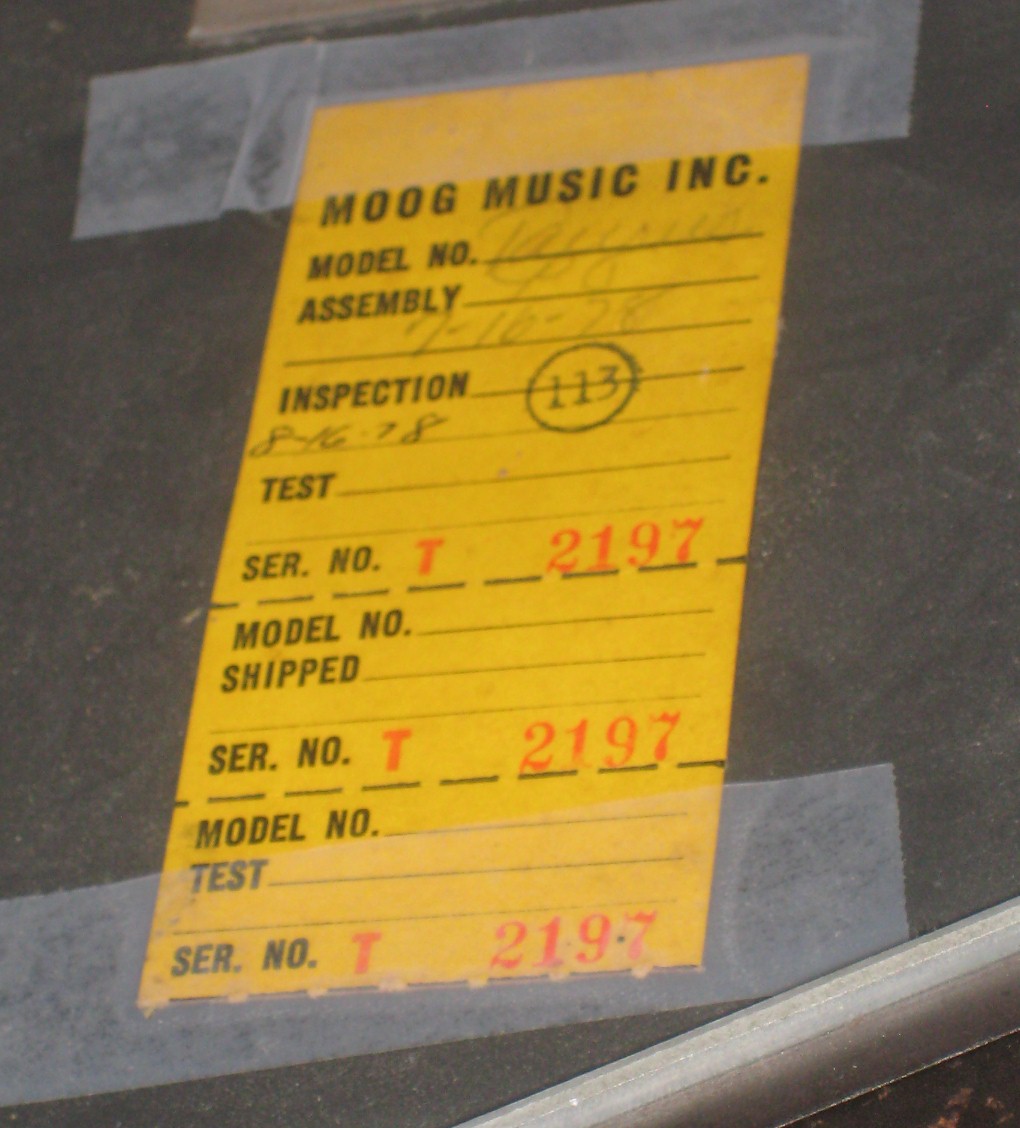
2197 |
| Sphere reference |
# 10888 |
| Statistics |
Created on : 05/04/2013 |
|
Changed on : 07/04/2013 |
| |
Published on : (Not published) |
| |
Displayed : 1867 time(s) by members and guests |
| Safety |
All electrical items sold in VEMIA are deemed to be trade sales. No warranty of electrical safety is given or implied. Many items are vintage and would not pass current electrical safety standards. It is the responsibility of the buyer to ensure that items are safe to use in their future environment - if necessary by using the services of a professional. |
|
|
|
|
|
|
|
|
|
Prices and conditions  |
 top top |
|
|
|
The following section gives you the prices as well as shipment and payment conditions associated with the item. Payment is always requested in GBP. Converted price is shown for information and converted with Sphere standard currency rate.
Shipment and Payment links gives you access to an extended description of our rating :
| Start price |
1400 GBP |
| Converted price (1) |
1400 GBP |
| Shipment |
International or local shipment to pay |
| Packing costs |
0 GBP |
| Payment |
Full pre payment needed |
| Auction bid step |
20 GBP |
| Auction highest bid |
0 GBP |
| Converted highest bid |
0 GBP |
| Leader or winner |
*None |
| (1) Currency conversion |
Note that conversion rates were last adjusted on 15th September 2026 at 16:52 CET. They are there to give you a rough guide to the bid price in your currency. Please check for a more up-to-date conversion at https://www.x-rates.com/calculator.html. The bid price will be the actual price in pounds (GBP) at the moment the auction closes. This will be roughly converted to your currency for your information.
For technical reasons, we are unable to update the conversion from GBP to Euro during the auction, although it may change at any time. If you are in the euro zone please check the current rate at https://www.x-rates.com/calculator.html
Payments must always be in GBP. For more info please see the FAQ about exchange rates.https://spheremusic.com/Winfaq.asp?Question=91. |
|
|
|
|
|
|